



YOUTH AS ARCHITECTS OF AN ALTERNATIVE TO THE BRETTON WOODS PARADIGM

Ms. Yojna Kapoor
WINNER: BRICS CCI’S YOUTH LEADERSHIP DIALOGUE 2.0
ABSTRACT
This paper scrutinizes the emergence of BRICS+ as a potential alternative to the Bretton Woods paradigm through the theoretical framework of polycentric governance. It examines the bloc’s institutional architecture, particularly the New Development Bank (NDB) and the Contingent Reserve Arrangement (CRA) and its strategic policy shift toward de-dollarisation. A specific emphasis is placed on the bloc’s youth demographic, comprising over 1.9 billion people under the age of 35. Furthermore, both the economic role and governance inclusion of youth are critically explored. Analysing secondary data from the IMF, World Bank, ILO, UN, and BRICS+ summit reports, the study integrates statistical indicators of GDP, trade settlement patterns, and youth employment/unemployment. The findings reflect that while BRICS+ exhibits decentralised and highlights multipolar governance features, youth engagement remains peripheral. The paper argues that structural integration of youth into governance can surely enhance institutional legitimacy, innovation, and resilience. Policy recommendations for a BRICS+ Youth Council, along with targeted employment schemes, are provided.
KEYWORDS
BRICS+, Polycentric Governance, Bretton Woods, De-dollarisation, Youth Employment, New Development Bank, Contingent Reserve Arrangement.
1. INTRODUCTION
1.1 Background of the Topic
The Bretton Woods system, established in 1944, institutionalised a centralised financial governance order through the International Monetary Fund (IMF) and the World Bank. While effective in stabilising post-war economies, it entrenched asymmetrical power relations, particularly in its quota-based voting structure, which disproportionately favours the United States and European Union (Vestergaard & Wade, 2015; Gallagher & Kozul-Wright, 2019).
BRICS—originally Brazil, Russia, India, China, and South Africa—emerged in the early 21st century as an economic coalition advocating for multipolar governance. The bloc’s extension in 2024 to BRICS+ (adding Egypt, Ethiopia, Iran, and the United Arab Emirates) expanded the share to 45% of the global population and 35% of the global GDP (PPP) (Statista, 2024).
Uniformly significant— the bloc’s demographic profile is approximately 1.9 billion citizens under 35 (World Economic Forum, 2024). From the standpoint of polycentric governance—a framework advocating multiple, overlapping centres of decision-making (Ostrom, 2010)— this youth population represents a metamorphic asset for innovation, legitimacy, and intergenerational equity.
2. LITERATURE REVIEW
2.1 Polycentric Governance
Polycentric governance describes systems where multiple autonomous centres of authority operate under a shared set of rules (Ostrom, Tiebout & Warren, 1961). This approach fosters adaptability, redundancy, and participatory legitimacy (Jordan & Huitema, 2014).
2.2 Bretton Woods Paradigm
The IMF and World Bank retain centralised decision-making based on quota-weighted votes. Reform efforts have been repeatedly blocked by major shareholders, leading to perceptions of institutional gridlock (Vestergaard & Wade, 2015).
2.3 BRICS+ Institutional Design
The NDB grants equal voting rights to founding members, avoiding veto structures. The CRA offers a $100 billion liquidity pool to reduce IMF reliance. Expansion in 2024 also signalled a stronger push for local currency trade settlements—a de-dollarisation strategy with implications for global financial multipolarity.
2.4 Youth in Global Governance
Global frameworks like the UN Youth2030 strategy and the G20’s Youth 20 process highlight youth as governance stakeholders, though largely in advisory roles. BRICS+ currently channels youth engagement through summits and cultural exchanges without granting institutional voting power.
3. METHODOLOGY
This study uses a qualitative institutional analysis supported by descriptive statistical analysis.
3.1 Data Sources:
- IMF COFER database for currency composition of reserves
- World Bank & ILO for youth labour statistics
- BRICS+ summit communiqués and NDB annual reports
- UN and WEF demographic datasets
- Peer-reviewed academic literature
3.2 Analytical Approach:
- Comparative institutional feature mapping
- Time-series analysis of de-dollarisation trends (2015–2024)
- Cross-sectional analysis of youth unemployment rates (2024)
4. RESULTS & ANALYSIS
Figure 1 – Comparative Governance Features: Bretton Woods vs BRICS+
Visual matrix comparing centralisation, voting rights, currency dominance, and youth participation. Source: NDB (2023); IMF (2024).
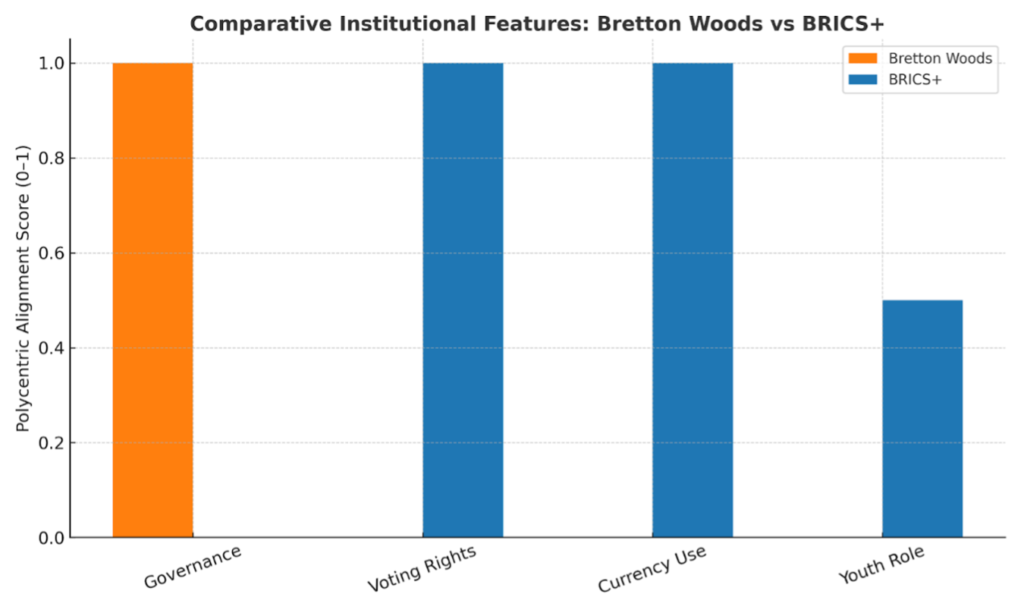
The first estimate juxtaposes the Bretton Woods institutions—IMF and World Bank—against the BRICS+ model. Bretton Woods remains very centralized, with voting through quotas heavily skewed towards the interest of the developed economies. The financial contribution heavily biases decision-making authority in these organizations, providing the United States and EU with a structural advantage. The NDB—BRICS+’s flagship development bank—has an equal-vote structure among the founding members, abandoning single-country veto powers. It is an expression of a polycentric concept: decentralizing decision-making authority among a myriad of centres and not a monolithic centre.
In terms of currency usage, Bretton Woods institutions are still USD-dominated, institutionalizing dollar dominance in international finance. BRICS+, on the other hand, is favourably encouraging local currency settlements, a central tenet of its de-dollarisation campaign. In terms of youth participation, however, both systems do not succeed—BWI has outreach programs with no compelling impact, while BRICS+ has youth forums with no organized involvement of youth in decision-making structures.
Figure 2 – BRICS+ Share of Global GDP (PPP) & Population (2024)
Pie chart showing BRICS+ accounting for 35% of global GDP (PPP) and 45% of global population. Source: Statista (2024).
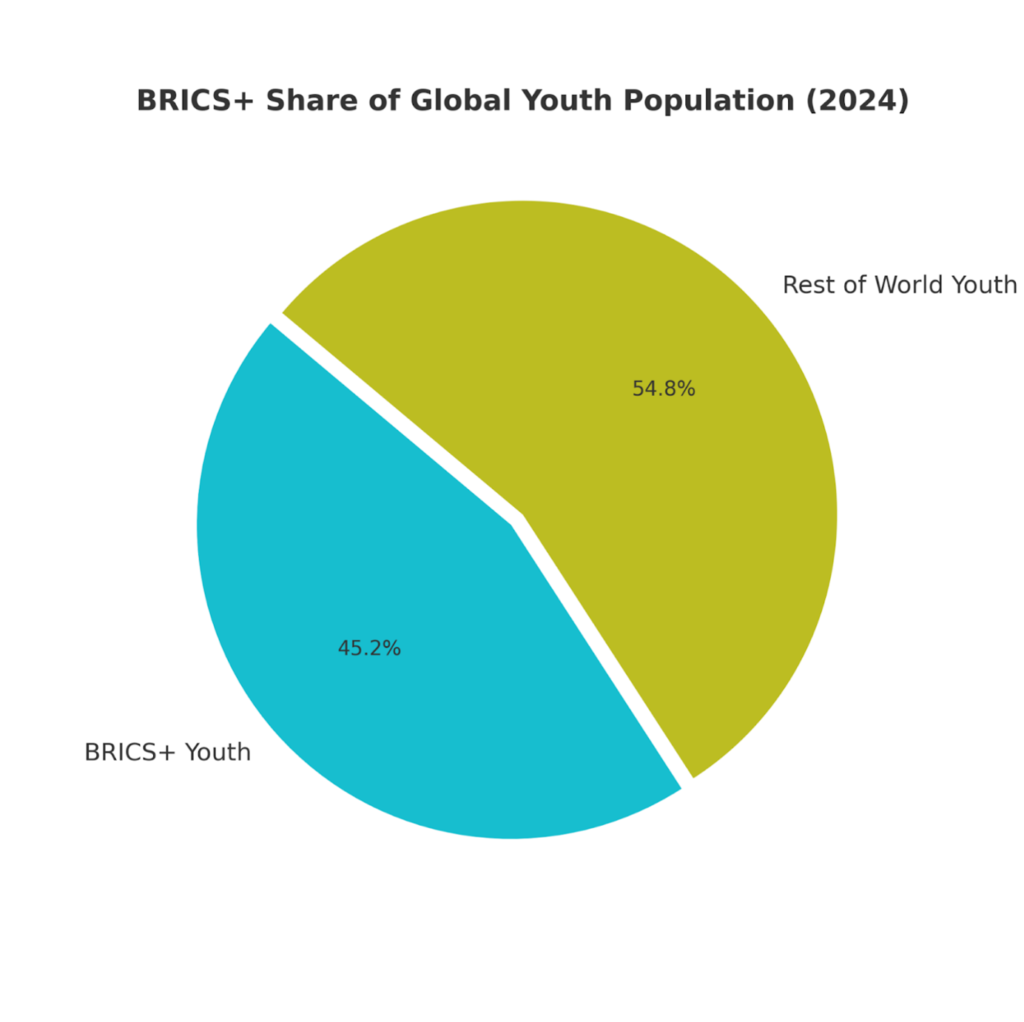
The above table evaluates the structural importance of BRICS+ in light of the world’s economic environment and population statistics. With a population of 3.6 billion, the group carries 45% of the world’s population, and the total GDP (PPP) of the group will represent about 35% of world output. This twofold advantage, both in terms of the size of the market and production base, gives BRICS+ phenomenal bargaining leverage in the formation of alternative models of international governance.
On the polycentric conception of scale, BRICS+ can play a role as a counterweight to Western-led economic institutions, but especially in policy areas like infrastructure finance, trade facilitation, and technology cooperation. However, if the members cannot act collectively on policy, this potential is lost.
Figure 3 – Intra-BRICS+ Local Currency Settlement Growth (2015–2024)
Line graph showing rise from <5% in 2015 to ~28% of intra-BRICS trade in 2024, with sharp acceleration post-2020 due to coordinated de-dollarisation policies. Source: BRICS (2024); IMF COFER (2024).
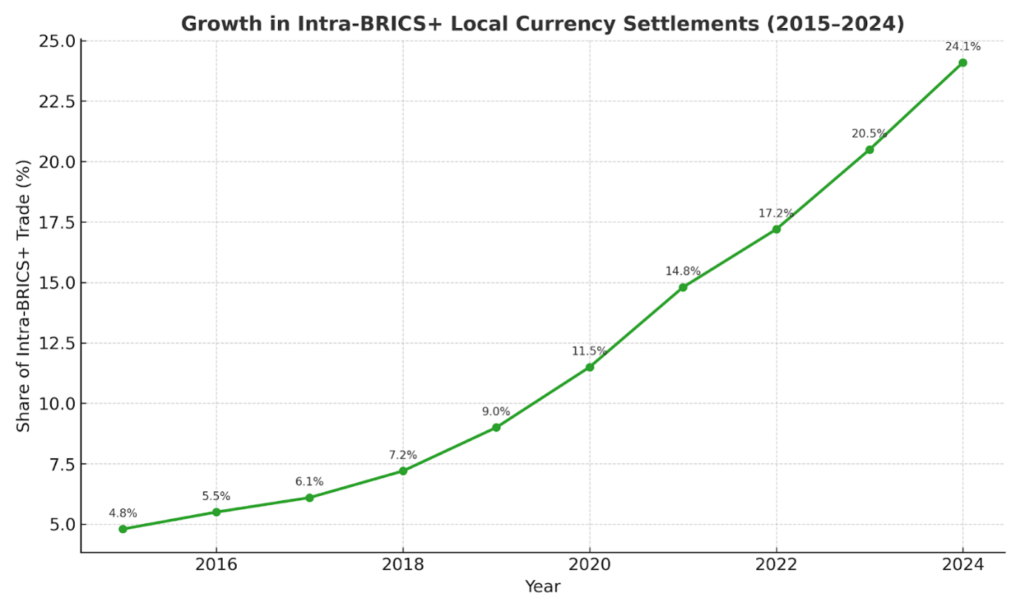
The third graph tracks the bloc’s de-dollarisation process, as evidenced by intra-BRICS levels of local currency settlements. Local currency settlements rose incrementally from less than 5% to around 10% for 2015-2019. But since 2020—due to pandemic-induced supply chain disruption, Western sanctions against Russia, and coordinated currency swap agreements—growth picked up to ~28% by 2024.
This move is more than symbolic; it is a deliberate move away from the dollar-denominated financial system, thereby reducing vulnerability to exchange rate fluctuations and US monetary authorities’ decisions. It also increases the monetary independence of the bloc, one of the constitutive principles of polycentric governance, wherein the different actors have independence over their own monetary paths.
Figure 4 – Youth Unemployment Rates in BRICS+ Countries (2024)
Bar chart showing highest rates in South Africa (53%), Egypt (28%), and Brazil (21%); lowest in China (12%) and UAE (10%). Source: ILOSTAT (2024).
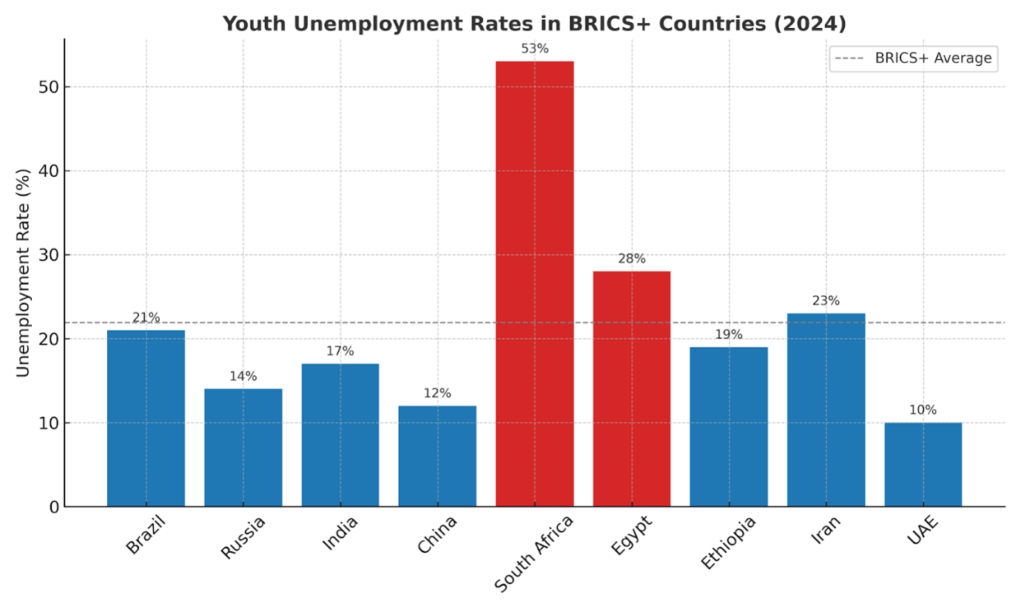
The fourth graph shows a major socio-economic concern: youth unemployment. The gaps are wide—youth unemployment in South Africa is over 50%, a pointer to underlying employment shortages and skill imbalances, while China and the UAE have rates under 12%. The wide gap is largely due to targeted vocational training and state-led job programs in these nations.
This divergence highlights policy environment heterogeneity in BRICS+. Unemployment poses risks to political stability, economic efficiency, and the legitimacy of governance arrangements. Polycentricity has the capacity to counter these threats by encouraging decentralized, locally adapted employment initiatives—yet leveraging the collective capacity of the bloc to up-scale initiatives, i.e., youth entrepreneurship funds and schemes for skill mobility.
Figure 5 – Polycentric Governance Model for Youth Integration
Conceptual diagram showing multiple governance nodes—national governments, NDB, CRA, BRICS+ Youth Council—interlinked with feedback loops to ensure inclusivity and resilience.
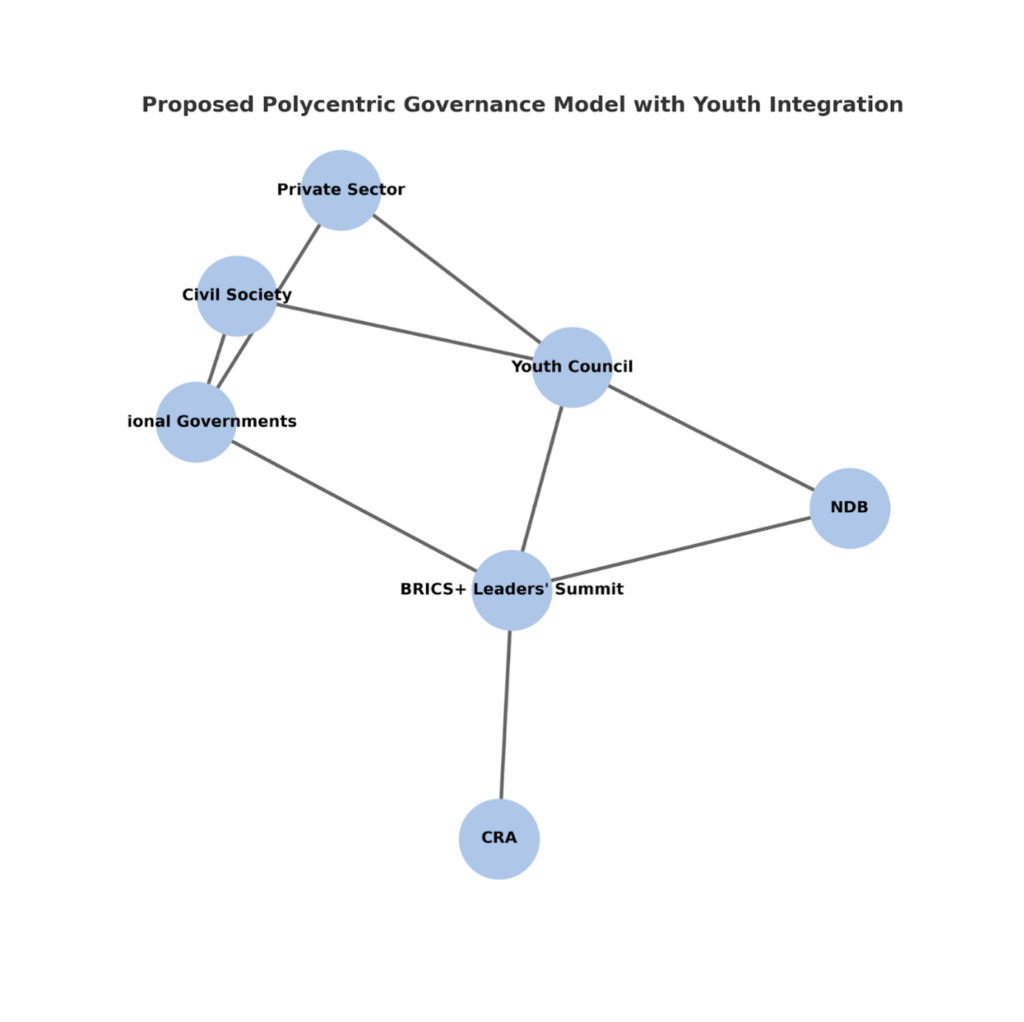
The final figure proposes an institutional blueprint for embedding youth in BRICS+ governance. The model envisages:
- National Governments implementing domestic youth employment and innovation policies.
- The NDB providing targeted funding for youth-led infrastructure, technology, and green energy projects.
- The CRA serving as a safety net for economic shocks affecting youth employment.
- A BRICS+ Youth Council with agenda-setting rights, feeding into ministerial-level decisions.
- Feedback loops between these nodes would ensure continuous policy adaptation, embodying the resilience and responsiveness that polycentric governance promises.
Key Analytical Insights:
- BRICS+’s institutional architecture already embodies aspects of polycentric governance, particularly in its decentralised financial structures.
- Its demographic advantage—especially its vast youth cohort—remains underleveraged due to a lack of formal governance integration.
- Economic policies like de-dollarisation are advancing steadily, creating opportunities for financial autonomy.
- High youth unemployment in several member states is a governance challenge that could be mitigated through multi-node, coordinated interventions.
5. DISCUSSION
BRICS+ is a stark departure from historical power arrangements in global economic governance under the Bretton Woods regime. Its distributive voting system in the NDB, lack of veto provisions, and enlargement to include a broader number of emerging economies represent a deliberate attempt to rebalance international agency. These characteristics are especially suited to Ostrom’s (2010) polycentric governance, which focuses on the responsiveness and resilience of multi-centered systems of power instead of a single hierarchical node.
5.1 De-dollarisation as Strategic Polycentricity
The bloc’s initiative toward local currency settlement and non-U.S. dollar diversification is something more than a money policy—it is a structural change to rebalance the system. The IMF COFER database indicates that for the period 2015-2024, the BRICS+ countries as a whole developed local currency intra-bloc trade share from below 5% to almost 28%, where Chinese yuan and Indian rupee were being utilized as settlement currencies for commodities and energy. This is duplicating polycentric wisdom in decentralizing power of financial transactions across many nodes and lowering exposure inherent to use of a single reserve currency.
But such a policy is also full of exchange rate risk on member currencies, asymmetric bilateral trade balances, and no collective clearing mechanism. These are impediments to cooperative monetary management that can be a possible place where fintech innovation by the youth can be the actual game-changer.
5.2 Youth Demographics: Asset or Liability?
With 1.9 billion under the age of 35, BRICS+ contains one of the biggest cohorts of young people globally. According to the International Labour Organization (ILOSTAT, 2024), while few members (UAE, China) have relatively low youth unemployment (10–12%), others are experiencing crisis-levels—53% in South Africa, 28% in Egypt, and 21% in Brazil. This “youth bulge” can become a demographic burden, driving socio-economic volatility, unless acted upon.
Under a polycentric approach to governance, youth participation in decision-making is of a twofold nature:
- Policy Innovation – Technological savvy, entrepreneurial drive, and flexibility are contributed by the younger generations to the realm of governance.
- Legitimacy and Intergenerational Equity – Participation ensures policies made today are legitimate for those living with their long-term effects.
- Youth engagement in BRICS+ is currently mediated through fora like the BRICS Youth Energy Summit and cultural exchange, which—if positive—are advisory and non-binding. The lack of an enabled, formalized forum for youth governance leaves a gap between institution and rhetoric at the structural level.
5.3 Lessons from National Policy Experiments
National policy experiments have been conducted by individual members of BRICS+ that would be scalable:
- India’s Skill India Mission has already upskilled more than 10 million youth across industry sectors from IT to renewable energy.
- Brazil’s Jovem Aprendiz program requires private corporations to recruit and train young employees.
- South Africa’s Presidential Youth Employment Initiative matches young people with short-term government work while developing skills profiles.
A BRICS+ Youth Employment & Innovation Strategy harmonized across all pillars could combine these learnings, establish success metrics, and leverage NDB financing to pilot scalable interventions.
5.5 Polycentric Youth Integration Model
The prospective BRICS+ Youth Council would be one of a number of governance “nodes” encompassing national governments, the NDB, and the CRA. This might enable distributed agenda-setting, cross-border policy-sharing, and early-stage funding for youth-led projects. By formalizing such a council in the decision-making process—granting it powers to put proposals forward for the consideration of the annual BRICS+ leaders’ summit—polycentric principles would be operationalized.
6. CONCLUSION
The analysis confirms that BRICS+ has been successful in shaping a system of governance that varies radically from that of the Bretton Woods system, with key characteristics of polycentric governance such as decentralised voting rights, diversified instruments of finance, and increasing membership. The de-dollarisation process of the bloc not only reconfigures the geopolitics of monetary power but also proves the viability of decentralised institutions in enacting systemic change without the need for the prevailing hegemonic order.
The youth axis is underutilized, though. Young people are not plugged yet into the formal decision-making framework of BRICS+, but are more than half the population of the bloc. By excluding them, the bloc may be missing out on a demographic dividend that can be utilized to enhance innovation capacity, democratic legitimacy, and socio-economic resilience.
6.1 Policy implications are:
- Institutional Innovation: Establishment of a BRICS+ Youth Council with agenda-setting powers, linked to the NDB for youth project funding.
- Economic Integration: Converged youth job programs aligned with best practices from member nations, focusing on learning in areas such as digital finance, renewable energy, and health technology.
- Financial Sovereignty: Developing fintech-based solutions—heretofore long in the vanguard of young entrepreneurs—to solve the issue of cross-currency settlement, thus facilitating de-dollarisation.
- Measurement and Accountability: Establishing strict indicators to monitor youth engagement in government and labor throughout the bloc.
- Technically, polycentric governance can only realize its full potential when its “multiple centres” are states and institutions as well as generational stakeholders. Institutionalizing youth into governance, BRICS+ not only would be a more legitimate counterweight to the Bretton Woods system but also be building towards a sustainable, intergenerational multipolarity.
7. REFERENCES
- BRICS, 2024. Johannesburg II Declaration. Johannesburg: BRICS Summit 2024.
Available at: https://brics2024.gov.za/declaration - Gallagher, K.P. and Kozul-Wright, R., 2019. A New Multilateralism for Shared Prosperity: Geneva Principles for a Global Green New Deal. Boston: Boston University GDP Center / Geneva: UNCTAD.
Available at: https://unctad.org/system/files/official-document/gdsmdp2019d1_en.pdf - IMF COFER, 2024. Currency Composition of Official Foreign Exchange Reserves. Washington, D.C.: International Monetary Fund.
Available at: https://data.imf.org/?sk=E6A5F467-C14B-4AA8-9F6D-5A09EC4E62A4 - ILOSTAT, 2024. Youth unemployment rate (% ages 15–24). Geneva: International Labour Organization.
Available at: https://ilostat.ilo.org/data/ - Jordan, A. and Huitema, D., 2014. Innovations in climate policy: Polycentric governance and the limits to decentralization. Global Environmental Politics, 14(3), pp.105–124.
Available at: https://doi.org/10.1162/GLEP_a_00240 - NDB, 2023. Annual Report 2023. Shanghai: New Development Bank.
Available at: https://www.ndb.int/annual-report-2023/ - Ostrom, E., 2010. Polycentric systems for coping with collective action and global environmental change. Global Environmental Change, 20(4), pp.550–557.
Available at: https://doi.org/10.1016/j.gloenvcha.2010.07.004 - Ostrom, V., Tiebout, C.M. and Warren, R., 1961. The organization of government in metropolitan areas: A theoretical inquiry. American Political Science Review, 55(4), pp.831–842.
Available at: https://doi.org/10.2307/1952530 - Statista, 2024. BRICS countries: share of global GDP (PPP) 2024. Hamburg: Statista.
Available at: https://www.statista.com/statistics/1214692/brics-share-of-global-gdp-ppp/ - United Nations, 2018. Youth2030: The United Nations Youth Strategy. New York: United Nations.
Available at: https://www.un.org/youthenvoy/youth2030/ - Vestergaard, J. and Wade, R.H., 2015. Still in the woods: Gridlock in the IMF and World Bank governance reform. Global Policy, 6(1), pp.1–12.
Available at: https://doi.org/10.1111/1758-5899.12178 - World Economic Forum, 2024. Global Youth Outlook 2024. Geneva: World Economic Forum.
Available at: https://www.weforum.org/reports/global-youth-outlook-2024/